The most common objection to multi-touch attribution from advertisers who spend heavily in TV, radio, and out-of-home is a reasonable one: "You can't measure what you can't see. We don't have user-level impression data for broadcast media — so how can MTA include it?"
The answer is the BOS signal. And it changes what an omni-channel model is capable of measuring — not by claiming more precision than the methodology supports, but by getting offline channels into the model at all. Inclusion is the prerequisite. Everything else follows from it.
Why Offline Channels Get Left Out
MTA models are built on touchpoint data — records of individual channel exposures for individual consumers on their path to conversion. For digital channels, this data is relatively accessible: ad server logs, site behavior, search query data, email engagement records. Each exposure creates a digital breadcrumb.
For broadcast TV, radio, and out-of-home, no such breadcrumb exists at the user level. A television ad reaches millions of viewers simultaneously. There is no server log, no impression tag, no cookie. The standard MTA data pipeline has no mechanism to record the exposure — so the channel simply does not appear in the attribution path.
The consequence is systematic. When TV is excluded from MTA, its credit redistributes silently to the digital touchpoints that do appear in the model. Paid search, display, and social all look more valuable than they are, because they are receiving credit for journeys that TV initiated. A model that calls itself omni-channel while excluding broadcast media is not omni-channel. It is a performance marketing scorecard that overstates the contribution of every channel it does measure, because it cannot see what created the demand in the first place.
This also means that TV impacts the apparent performance of everything else in the model. When TV campaigns run, branded search volume increases, direct traffic rises, and social engagement lifts. A model without TV cannot distinguish these dynamics from organic channel performance. Every other channel's measured contribution is partially wrong as a result.
What BOS Actually Measures
BOS stands for Blended Offline Signal — the behavioral footprint that offline media exposure creates in downstream digital activity. When a consumer is reached by a TV spot, a radio placement, or an outdoor campaign, the conversion rarely happens at the moment of exposure. It happens later: through a branded search, a direct website visit, a navigation from memory. BOS captures that downstream behavioral response and maps it back to the offline media that generated it.
The response signal is configurable. BOS can be run against branded search alone, against direct traffic, against social engagement, or against any defined combination of downstream channels. The default signal — the most consistent and most behaviorally interpretable — is branded search activity, because it marks the clearest transition from passive awareness to active intent. A consumer who searches a brand name is signaling something. BOS is designed to identify when offline media was the thing that triggered it.
The BOS signal works because broadcast media exposure creates a predictable and measurable spike in branded search volume. When a TV campaign runs, branded search queries increase. When the campaign stops, they return to baseline. When a specific radio creative runs in a specific DMA, branded searches in that geography increase. The pattern is consistent, replicable, and validatable against the media schedule. It is not perfect — but it is real, and it is in the model.
Three Ways to Get Offline Media Into the Model
BOS is not the only path. There are three distinct approaches, and they are not mutually exclusive.
Connected TV (CTV) is the cleanest version. CTV delivers TV-quality advertising through internet-connected devices, which means device-level impression records exist. These are deterministic signals — no inference required. A CTV impression is attributed in the same way as any digital touchpoint, because it effectively is one. For advertisers with CTV investment, this is the highest-confidence method for getting TV signal into the attribution model. Linear TV via BOS and CTV in the model simultaneously is the most complete approach available.
Direct response mechanics — personalized landing pages, dedicated phone numbers, QR codes — provide clean, deterministic signals for the consumers who respond through those specific mechanisms. They are precise but partial. The audience that scans a QR code and converts directly is measurable with high confidence. The much larger audience that saw the same ad, did not respond immediately, and converted weeks later through branded search is not captured by these methods. Direct response mechanics are valuable as a complement to BOS, not a replacement for it.
BOS is probabilistic and comprehensive. It does not capture every individual who was influenced by a TV spot. It identifies the population-level behavioral response — the branded search lift that correlates with the media schedule — and converts that into attribution credit distributed across the exposed audience. Less precise per individual than a QR code conversion; representative of the actual audience in a way that QR code conversions are not.
The Mechanism: From Exposure to Signal
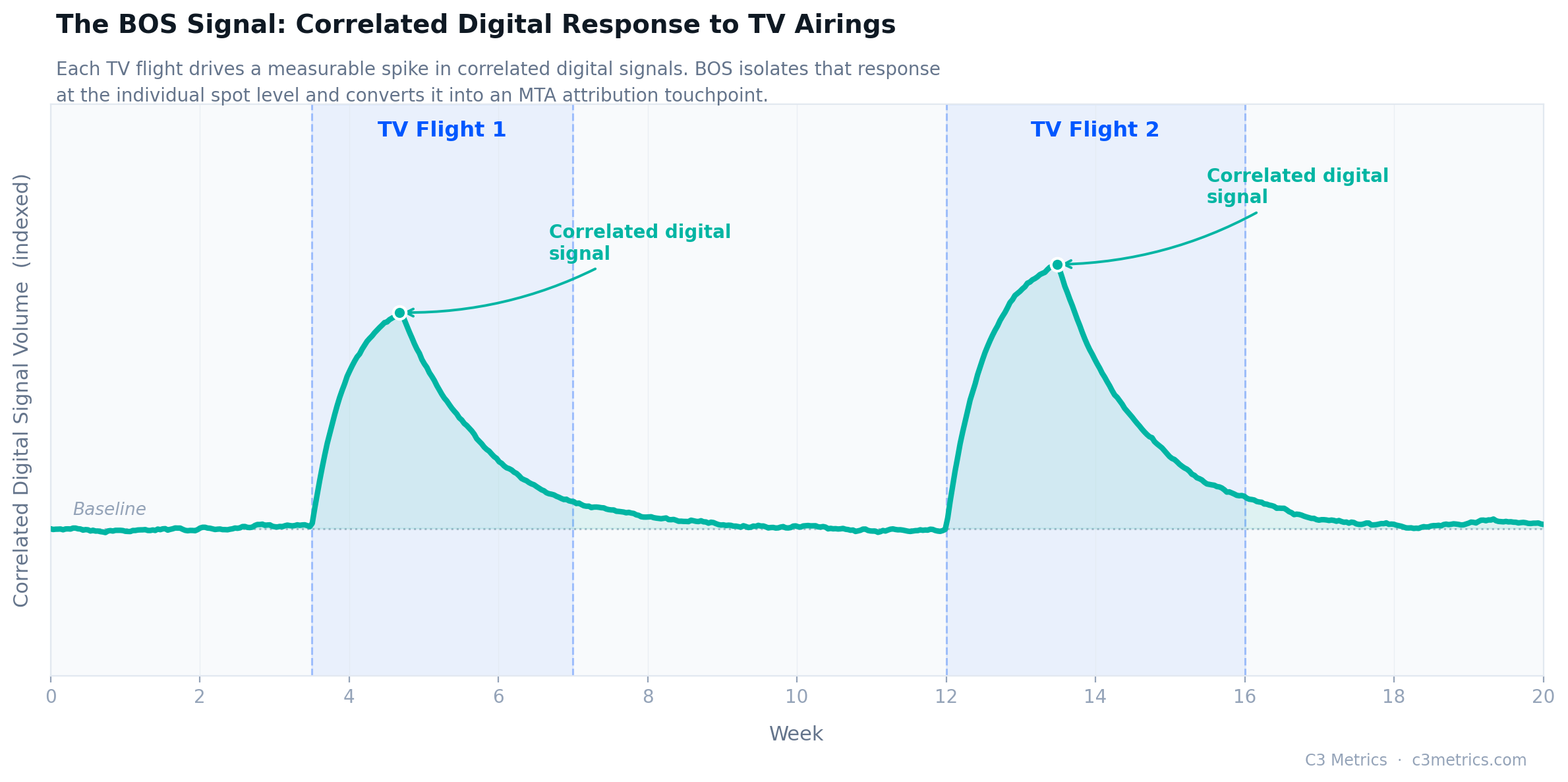
The attribution logic works as follows. A consumer sees a TV ad. They do not convert immediately — most do not. But they now carry an awareness of the brand. Days or weeks later, they enter the active consideration phase and search for the brand by name. That branded search query is captured as a touchpoint in the MTA model. When they eventually convert, the branded search appears in their path — and the BOS methodology identifies it as the behavioral consequence of a TV exposure, not an independent organic search.
The critical step is the media schedule validation. By correlating BOS volume fluctuations with the actual TV and radio flight schedule, C3 Metrics can establish which branded searches were statistically linked to offline media exposure versus which represent organic brand interest. The two populations are attributed differently — the BOS-tagged searches carry the TV or radio channel credit, while organic brand searches are attributed as direct brand equity.
It is worth being precise about what this is and is not. The branded search touchpoints are real digital signals, captured in the same data pipeline as every other touchpoint in the model. What BOS provides is the methodology to distinguish which of those searches were generated by offline media exposure — and that distinction rests on statistical correlation with the media schedule, not on direct observation of the original TV impression. The touchpoint is real. The attribution of its origin to offline media is a probabilistic inference, validated at the DMA level against the flight schedule.
Validating the Signal
The validity of BOS attribution rests on the correlation between media schedule and search volume, tested at the DMA level and controlled for seasonality, competitive activity, and organic brand growth trends. A television campaign that creates a genuine BOS response will show statistically significant branded search volume increases in the geographies where the campaign ran, timed to the flight schedule, and not explainable by other factors.
This is probabilistic measurement. That is not a limitation unique to BOS — it is the nature of broadcast media. A linear TV ad reaches a probabilistic audience. BOS applies the most rigorous available analytical framework to identify that audience's behavioral response. The methodology is the same category of inference that media mix modeling uses for all offline channels; BOS produces a touchpoint-level signal rather than a model-level estimate, which makes it integrable into the MTA data pipeline alongside digital touchpoints.
The Unlimited Attribution Window
BOS gets offline channels into the model. The unlimited attribution window is what ensures the long tail of their influence is captured.
Standard attribution windows — 30 days, 60 days, 90 days — are set for digital channel convenience, not consumer behavior reality. For the categories where offline media is most significant — automotive, financial services, insurance, pharmaceutical — consideration cycles routinely extend beyond any of these windows. A consumer who saw a television ad in January, searched the brand in February, visited the site twice in March, and converted in April represents a four-month attribution journey. A 30-day window treats the February search as the originating touchpoint, because January's TV exposure falls outside the lookback period.
C3 Metrics uses unlimited attribution windows to capture these full funnels. This is not a methodological preference — it is the only way to build accurate journeys for channels whose influence operates on longer time horizons than digital performance marketing. BOS identifies the signal. The unlimited window ensures the journey that follows is not cut off at an arbitrary boundary.
What BOS Understates — and How We Quantify It
BOS will understate TV's importance. This is an honest acknowledgment of what probabilistic methodology can claim, and it is worth stating directly rather than burying.
BOS captures the branded search response to offline media. It does not capture every downstream effect of a TV campaign. Viewers who were influenced by a television ad and converted through direct traffic, unbranded search, or a return visit from a saved bookmark without generating a BOS-identifiable branded search signal are attributed to those downstream channels, not to TV. The halo effect — the lift that TV creates across paid search conversion rates, social engagement, and direct traffic — is real and documented, but only partially captured by BOS alone.
The understatement is quantifiable. By testing the halo effect independently — measuring the lift in all downstream channels during TV flight periods versus non-flight periods — it is possible to estimate the gap between what BOS attributes to offline media and what TV actually contributed. This gives the model something more valuable than precision: known bounds. A conservative estimate with a quantified confidence interval is more useful for budget decisions than an inflated estimate of unknown reliability.
How Offline Channels Earn Their ORAC Position
Offline channels do not have a predetermined position in the ORAC taxonomy. They earn the position the data assigns them based on where they appear in the actual consumer journey.
In most programs that include TV via BOS, offline media is the most common Originator — the first touchpoint in journeys that ultimately convert. This reflects how broadcast media works: it reaches consumers before they have purchase intent, which is the defining characteristic of Originator activity. When TV is the first of several exposures, it registers as Originator. The digital channels that follow — paid search, retargeting, email — fill the Roster, Assist, and Converter roles.
But if TV is the only touchpoint before conversion — a single-touch journey where the consumer saw the ad and converted shortly after via branded search — the BOS-tagged branded search registers as Converter. That is where the data puts it, and the data is right. A model that forces TV into the Originator position regardless of the journey structure is not measuring what happened. It is asserting what it believes should have happened.
CTV makes this position assignment cleaner. Because CTV produces device-level deterministic signals, it can be placed in the attribution path with the same confidence as any digital channel. The ORAC position it receives reflects the actual journey, not a probabilistic inference about when in the path the exposure occurred.
What Changes When You Measure Offline Channels in the Model
When TV, radio, and OOH are included in MTA via BOS, several things change. Offline channels receive credit for the conversions they initiated — credit that was previously flowing to paid search and retargeting. Budget decisions become grounded in complete journey data rather than the performance marketing layer that sits on top of a demand-creation process the model could not previously see.
For advertisers in automotive, financial services, insurance, and pharmaceutical — categories where TV is a major channel and consideration cycles are long — BOS attribution can substantially change the measured ROI of the media mix. Channels that appeared to underperform in digital-only MTA frequently show strong performance once their BOS-derived attribution is included. More importantly, the channels that appeared to overperform — paid search on brand terms, in particular — are more accurately evaluated once the upstream demand creation that drove them is visible in the model.
Specialized TV measurement vendors can produce precise estimates of TV's impact on specific downstream metrics — branded search lift, website visits, conversion rate changes during flight periods. These are useful and rigorous measurements of a specific question. The limitation is scope: measuring TV's impact on branded search from outside the attribution model tells you that TV lifted search by a measurable amount. It does not show what happened across the rest of the journey, how the other channels interacted with the TV-generated demand, or where TV fits in the complete path from first exposure to conversion. A complete model requires both: TV in the attribution path, and the full journey context around it.
BOS signal integration is a core component of C3 Metrics' omni-channel measurement capability. For clients with significant TV, radio, or OOH investment, BOS methodology converts the behavioral footprint of offline exposure into first-class attribution touchpoints — giving broadcast media the same analytical standing as digital channels, with unlimited attribution windows to capture the full consideration cycle, and halo effect testing to quantify what BOS conservatively understates. The goal is a complete model, not a perfect one.