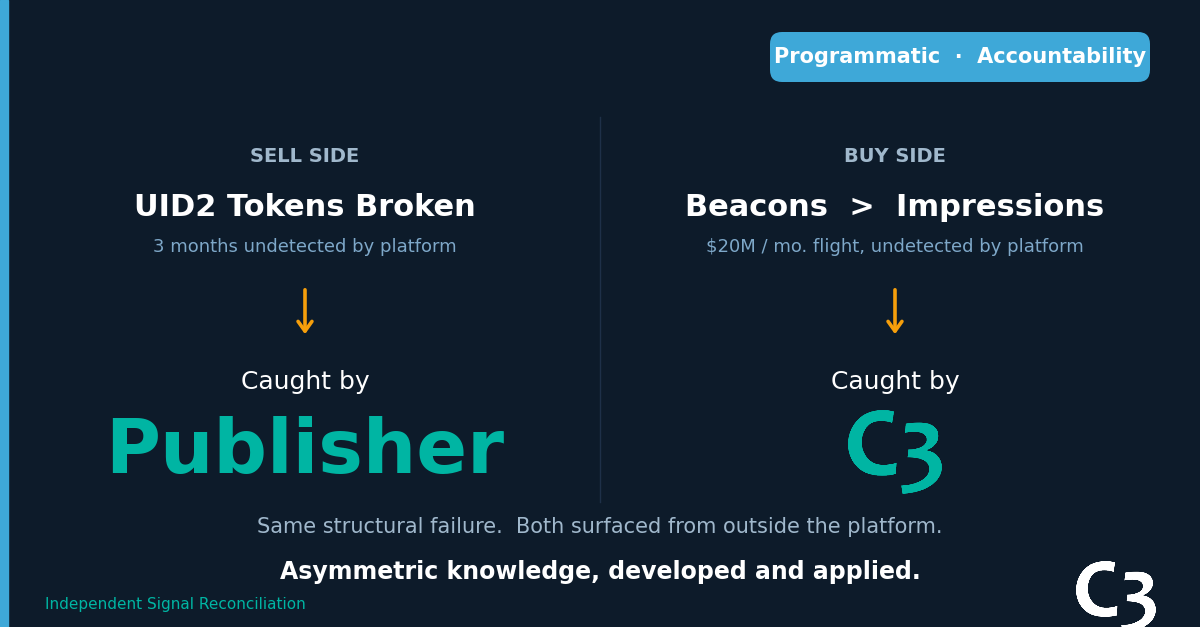
The Trade Desk confirmed this week that bad data passes through its own identity protocol undetected. We documented the same structural blind spot on the buy side earlier this year — in the form of something physically impossible.
What AdExchanger Found
AdExchanger reported this week that a major national CTV publisher ran a broken UID2 implementation for three months. The publisher was creating UID2 tokens with encryption errors that made them irreconcilable for ad targeting. Three months passed without a flag from the platform. Account reps gave positive feedback throughout. When the publisher independently discovered and fixed the error, revenue held flat in both directions.
TTD's SVP of Engineering confirmed to AdExchanger that the flawed tokens would have been useless for targeting. TTD also confirmed that the information available to the platform fell short of what would have been required to catch the problem.
“If there is no anomaly, it’s very difficult to identify the problem.”
— Waseem Basheer, SVP Engineering, The Trade Desk (via AdExchanger)
The publisher's conclusion was pointed:
“They clearly were unable to flag that we made an unintentional mistake. I'm not confident they would have been able to detect a malicious implementation, either.”
— Anonymous, Major CTV Publisher (via AdExchanger)
What We Documented on the Buy Side
The AdExchanger story is about the sell side. We have documented the equivalent on the buy side.
In a programmatic traffic quality audit covering a single monthly flight on a $20M-per-month buy, we identified TTD line items where viewthrough beacon counts exceeded impression counts. A physical impossibility, by definition. A beacon fires only when an ad is served. When the beacon count sits above the impression count, the delivery data has a structural integrity problem.
Physically impossible under any legitimate delivery scenario. Consistent with pixel stuffing, hidden ad stacking, or delivery reporting errors at the impression level. Surfaced by independent signal-level reconciliation — outside the financial chain that priced, delivered, and managed the campaign.
That finding was one of four signals in a single-month audit that estimated six-figure fraud cost on the buy. The full methodology — beacon-to-impression ratio, peer volume comparison, CPM-weighted fraud cost, and channel concentration analysis — is documented in What Programmatic Fraud Actually Costs. The point relevant to the AdExchanger story is the same: independent reconciliation surfaced what platform reporting did not.
The Structural Problem These Two Cases Share
The sell-side UID2 case and the buy-side beacon inflation case run on different mechanisms. The structure underneath them is identical.
Publisher passed broken tokens for 3 months. TTD's financial signal showed no revenue anomaly. The data quality failure stayed outside the platform's reporting view until the publisher caught it independently.
Line items showed beacon counts above impression counts. Platform reporting passed the line items as delivered. Agency reporting passed them as delivered. The finding emerged through independent signal-level reconciliation, run outside the buying ecosystem.
In both cases, the party best positioned to detect the problem held a financial relationship to the impression in question. In both cases, the problem surfaced through measurement that sat outside that financial relationship.
The pattern points to incentive architecture. Reliable auditing of data running through a platform's own pipes asks the platform to flag findings that reduce confidence in its own inventory or methodology — a request that runs against the financial logic of the platform's business.
How the Publisher Described It
The CTV publisher in the AdExchanger story characterized the architecture in pointed terms. The publisher's full framing belongs to the publisher. The operating reality the publisher describes is recognizable to anyone running independent reconciliation against platform-reported data.
“UID2s are giving a false sense of confidence in identity in an environment where there's a lot of garbage data going in and out, with a significant amount of opacity in the middle that The Trade Desk has purposely built to eliminate accountability. You can't audit and you can't track it.”
— Anonymous, Major CTV Publisher (via AdExchanger)
The narrower phrase — “you can't audit and you can't track it” — captures the practical condition of most programmatic delivery data. The technical capacity to audit exists. The willingness to publish findings sits with parties whose revenue is connected to the inventory under audit.
What Independent Measurement Does Differently
The Signal Manifest™ is C3's chain-of-custody documentation for every data source that enters an attribution model. It records what signal was used, where it came from, how it was verified, and what reconciliation steps were applied. It exists to replace “you can't audit and you can't track it” with documented chain-of-custody for every signal a $60 billion programmatic market relies on.
The beacon inflation finding above emerged from independent signal-level reconciliation — a comparison of platform-reported delivery data against attribution-layer signal counts, run from outside the platform.
The measurement that detects the problem stands apart from the measurement that placed the buy — an operational requirement at the level of audit integrity. The two cases documented here, one reported publicly by AdExchanger and one from our own client work, illustrate the difference that separation makes.
What Independent Reconciliation Surfaces
Our work is measurement of what media actually does. That work produces different numbers when the underlying data has integrity problems — and the difference is the finding that changes how a budget gets allocated.
For programmatic campaigns running at scale, three questions are worth raising in the next quarterly review:
1. Who is reconciling beacon-to-impression ratios on the line items independently of platform-reported delivery data?
2. What visibility exists into the data signals buyers are transacting against on the budget?
3. When a physical impossibility appears in the delivery data, what is the process for surfacing it?
Measurement that sits outside the financial relationship to the impression produces a different number than measurement run from inside it. Both cases here illustrate why that distinction matters at the level of how budget is allocated.
Asymmetric knowledge, developed and applied.
Source: AdExchanger, “A Publisher Didn't Get Its UID2 Setup Right. The Trade Desk Didn't Notice.” (May 7, 2026). C3 buy-side findings are documented in What Programmatic Fraud Actually Costs. Client identifying details withheld.